
The University of Notre Dame is reenvisioning the Midwest!
by THOMAS DIETZ
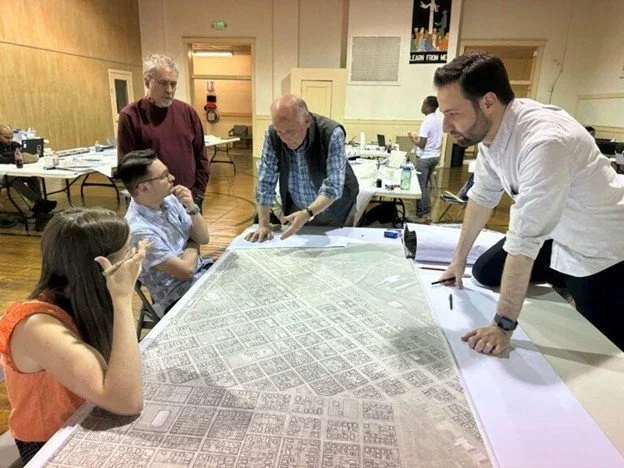
Image credit: ACCELRATE RURAL INDIANA
Few academic institutions are as friendly toward New Urbanism than the University of Notre Dame, and a recent initiative seeks to put those design principles into practice.  Led by Dean Stefanos Polyzoides and program Director Marianne Cusato, the Housing and Community Regeneration Initiative describes itself as a "Think-and-Do Tank” that functions as an academic consulting and design practice operating in the heart of the Midwest.

This Midwestern aspect is unique, where questions of urban blight, housing shortages, and economic development are particularly strong concerns affecting the region’s mid-sized urban areas. However, the initiative’s focus is even more local. Launched in 2021, the initiative specifically serves the "100-Mile Coalition,” a network of cities and nonprofits within 100 miles of the University’s campus. As an academic practice operating from within the School of Architecture, this initiative provides hands-on learning experiences, with faculty and student representatives actively partnering with cities to form broad, collaborative coalitions. 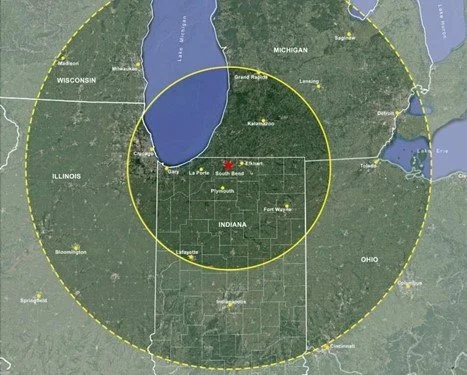
IMAGE CREDIT: THOMAS DIETZ
Operating principally through design charettes, the design process, final recommendations, and practical implementation unfold through four stages.  The first stage involves assessing a municipality through both historical and contemporary lenses.  By engaging key stakeholders and community members, the initiative seeks to identify a municipality’s aspirations and underlying design requirements, developing an appreciation for the unique aspects of each project before proceeding with design work.  The subsequent design phase involves an interactive workshop characterized by iterative refinement and real-time feedback, ensuring the final output incorporates contemporary community perspectives.  Once a finalized design approach is in place, the initiative’s design team will develop a final report that prioritizes the project’s key components and outlines the next steps.  Given the initiative’s specific regenerative development focus, these concerns often revolve around housing affordability and neighborhood density, as well as the establishment of preservation requirements, zoning reforms, and architectural design standards.  The final stage requires implementing a development strategy, thereby establishing the necessary processes to bridge a municipality’s history and future aspirations.

The initiative addresses five key areas of focus, as stated on the University’s website: “knowledge-sharing,” “de-dividing communities,” “holistic urban regeneration,” “making places where people and communities thrive,” and “growing the next generation of vision-keepers.”  These concerns are diverse and require a holistic response to the matters at hand, manifested through the New Urbanist principles of place-based regeneration and a focus on walkable, durable environments.
Given the initiative’s focus on addressing real-world problems, practical economics proves to be a central concern. The University’s website cites $120 million in regional impact generated through grant funding to its partner municipalities and nonprofits. Of that sum, $98 million is allocated to the initiative’s work in Kalamazoo, Michigan, which includes $25 million from the U.S. Department of Transportation’s Rebuilding American Infrastructure with Sustainability and Equity (RAISE) program. In Kalamazoo, these funds are to support improvements to downtown thoroughfares and public spaces, based on the city’s design charette, as derived from the initiative. Construction is to begin in 2027.
While implementing specific urban revitalization projects often requires external financial support, the initiative’s true economic objective is to cultivate self-sustaining communities supported by revitalized physical infrastructure and economic conditions. By restoring a community’s commitment to civic pride and identity, these projects aim to generate a culture of enduring financial investment for residents and developers alike. Additionally, these projects often acknowledge that substantial improvement to a community’s underlying tax base through business development is a desired outcome.
LaPorte, Indiana; Elkhart, Indiana; and South Bend, Indiana have all been subjects of design charettes, but the initiative’s work in Gary, Indiana has perhaps drawn the most attention. Gary is particularly iconic for its reputation as an economically depressed post-industrial city on the outermost periphery of the Chicagoland region, and reworking Gary into a dense, walkable city will require a particularly strong commitment to revitalizing urban planning priorities and business development.
The proposal for Gary is based on an August 2024 design charette. The final prognosis for Gary is a downtown revitalization focused on form-based zoning, prioritizing high-density, mixed-use buildings near the city’s core Broadway axis, which is conceived as the focus of a new Transit-Oriented Development, with an intermodal station at the northernmost end connecting bus transportation and commuter rail to highway access. By limiting traffic lanes, the city’s Broadway will foster a more pedestrian-friendly atmosphere. The neighborhoods to the east and west of this spine will be the focus of further real estate development. Architecturally, the initiative calls for the implementation of eight core housing designs tailored to the city’s 30-foot residential lots. The initiative also calls for significant reinvestment in key historic assets, prioritizing preservation over demolition. 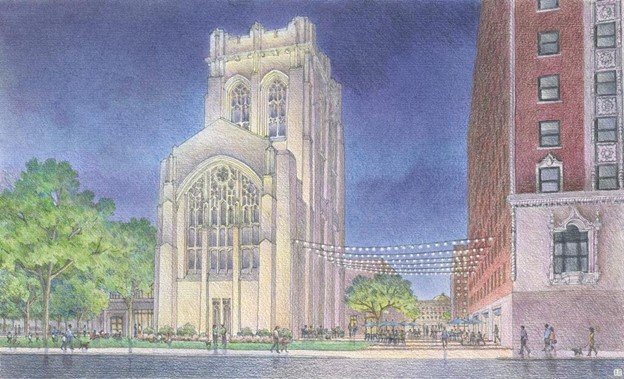
Projects such as these will undoubtedly prove fruitful for the Midwest. Beyond improving the lived experience, they provide an impetus for further urban development and economic investment elsewhere. Further, the initiative fills the gap between visionary urban design and actionable community development. Lastly, by grounding these charettes in the principles of New Urbanism and New Traditional Architecture, the initiative moves the University’s curriculum beyond abstract architectural theory to real-world economic and social renewal.Author Bio:
Thomas M. Dietz is a CNU-Accredited practicing architect in Chicago with JNKA Architects.