
Indiana’s READI Program Is Reshaping How the State Approaches Regionalism
by bRETT MORGAN
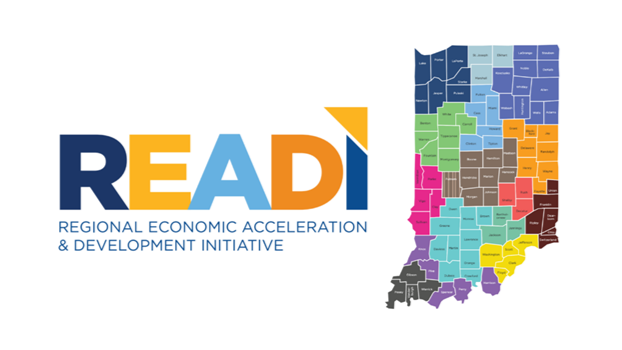
Image credit: ACCELRATE RURAL INDIANA
Indiana’s Regional Economic Acceleration and Development Initiative (READI) has become one of the most important shifts in how the state approaches regional planning and economic development. What began in 2021 as a $500 million push to get communities thinking beyond their borders has grown into a statewide framework for collaboration. READI 2.0 doubled the state’s investment, and Lilly Endowment added a $250 million grant (earmarked for blight remediation and arts), giving regions the resources and support to pursue projects they would have never attempted alone. For people working in place-based development, READI has pushed communities to behave like regions, something Indiana has historically struggled to do.Regions Formed Organically Are Nearly as Cohesive as State-Drawn Regions
A IU Kelley School of Business report published in August 2025 compared three different ways of dividing the state: the 15 READI regions, the 11 state-drawn Economic Growth Regions (EGRs), and the 15 federally defined Metropolitan Statistical Areas (MSAs). The key measure was commuting tightness, which captures the share of residents who live and work in the same region. The results were closer than expected. READI regions averaged 87.7%, EGRs averaged 89.1%, and MSAs averaged 86.8%. The report notes that “the difference in commuting tightness between READI regions and EGRs is insignificant.” In other words, the regional communities formed voluntarily, based on relationships, shared labor markets, and practical cooperation, perform almost as well as the regions engineered by the state. A strong endorsement of a bottom-up approach to regionalism.READI Has Forged a New Layer of Regional Governance
The most important outcomes of READI aren’t singular projects or dollar figures. It’s the emergence of informal regional governance. The IU Kelley report highlights that through the READI process, “jurisdictions learned how to work together with no external body dictating the way cooperation should occur.” That’s a major cultural shift. Indiana’s economy functions regionally, but its governments operate locally. READI didn’t change the legal structure, but it created conditions for counties and cities to build trust, share information, and plan together. Central Indiana is the clearest example: three separate READI 1.0 regions merged into a single regional development authority for READI 2.0. This only happens when people have spent time working through real projects and seeing the value of acting as one region. This informal governance is likely to outlast the grant cycles.The Economic Impact Is Significant, but the Mindset Shift Matters MorE
READI’s economic impact is usually described in terms of leverage - billions in private and local dollars pulled into housing, childcare, redevelopment, and infrastructure. But the more interesting impact is how it has changed the conversation inside communities. Because READI requires regions to submit strategic plans focused on population growth, talent, and quality of place, it has forced local leaders to connect issues that are often considered separately: housing supply, workforce attraction, childcare access, downtown revitalization, and trail networks. These projects change from ‘maybe someday’ to ‘let’s do it’. They have become core economic development strategies for communities. The Kelley report also highlights where the challenges lie. Several southern regions have tightness scores below 70%, including Southeast Indiana at 55.2% and Indiana First at 57.6%. These numbers reflect strong ties to out-of-state metros, which complicates how state dollars translate into local impact. For planners and urbanists, this reinforces the importance of housing near job centers, walkable neighborhoods, and strong local amenities, because those are the levers that keep workers and families rooted.Lilly Endowment’s $250 Million Grant Has Shaped the Future of READI
Lilly Endowment’s $250 million contribution to READI 2.0 didn’t just add funding, it changed the scale and ambition of the program. It expanded READI 2.0 from a $500 million state initiative to a $750 million statewide effort, giving regions the ability to pursue transformational projects rather than incremental ones. It also sent a clear signal: quality of place should not be considered a luxury. It’s central to Indiana’s long-term competitiveness. For a state that has historically underinvested in placemaking, the Lilly Endowment grant has shifted the tide.What’s Next for Regional Planning in Indiana
The Kelley report recommends adopting the 15 READI regions as the state’s official planning regions. Arguing that they’re nearly as economically cohesive as the state’s engineered regions. They already have functioning relationships and shared planning habits. They reduce administrative friction because the collaboration infrastructure is already in place. If Indiana adopts them, it would be the first time the state’s planning map reflects how communities behave rather than how agencies prefer to organize them. READI has created a statewide laboratory for regionalism, and the early data suggests that bottom-up regions can be just as effective, and often more effective, than top-down ones.Key Data from the Kelley School READI Regions Assessment
Commuting Tightness
READI regions: 87.7%
Economic Growth Regions (EGRs): 89.1%
Metropolitan Statistical Areas (MSAs): 86.8%
Lowest Tightness Scores
Southeast Indiana: 55.2%
Indiana First: 57.6%
Accelerate Rural Indiana: 66.9%
Our Southern Indiana: 68.7%
Why This Matters
Tightness measures how well a region captures its own labor shed. Higher tightness means more of the region’s economic activity stays inside the region. The report concludes that READI regions “adequately capture regional market activity” and that the difference between READI regions and state-drawn regions is “insignificant.”Learn More
Indiana READI Program: https://indianareadi.com Author Bio:
Brett Morgan is Director of Development at Meyer Najem, a construction and development firm headquartered in Fishers, Indiana. He joined the team in 2025 after leading transformative capital projects across Indiana’s public and private sectors. His career spans over a decade of civic and economic development, including leadership roles at the Indiana Economic Development Corporation and the City of Indianapolis.
Brett lives in Indianapolis with his wife and daughters.